 LED Savings
Efficacy Index
← Back to guides
LED Savings
Efficacy Index
← Back to guides
Corrected 15 August 2026: the energy argument worked example below stated a $0.30/kWh electricity rate but its dollar figures were only consistent with $0.20/kWh; recalculated at the stated rate. Airport Link’s opening year was corrected from 2011 to 2012 (Clem7’s 2010 date was already correct). The IES RP-22 reference now notes it has since been consolidated into ANSI/IES RP-8.
Why Tunnel Lighting Is Different from Every Other LED Application
Most LED specification work deals with a single lighting condition: a space at a fixed ambient luminance, with a target lux level, and a relatively stable human visual environment. Tunnel lighting deals with something fundamentally different: a moving observer transitioning between radically different luminance conditions, while operating a vehicle at speed, in a confined space where a visual failure has immediate safety consequences.
The engineering challenge is not simply "how many lumens per metre." It is: how do you maintain safe visual conditions for a driver whose eyes are adapted to 30,000 cd/m² of Australian summer sunlight, entering a space where the walls are at 30 cd/m²? That transition, and the controlled management of it, is what tunnel lighting design is actually about.
The Human Visual System: Why the Entrance Zone Is Critical
The human eye adapts to ambient luminance through two mechanisms: the iris (fast, limited range) and photochemical adaptation in the retina (slow, large range). Moving from bright sunlight into a dimly lit tunnel, the iris responds almost instantly but the photochemical adaptation takes 3 to 5 minutes to complete. During that adaptation period, the driver's visual system is operating at the luminance level it was adapted to, not the level that now exists in front of them.
The result is the "black hole" effect. From outside a tunnel entrance, the interior appears entirely dark. The driver cannot see vehicles stopped inside, lane markings, debris, or any hazard. This is not a perception problem. It is a physiological reality: the eye is still adapted to outdoor luminance levels, and the interior luminance is simply below the threshold of useful vision for that adaptation state.
The engineering response is to bring the entrance luminance up to a level that is visible to a fully outdoor-adapted eye, then step it down progressively as the driver penetrates the tunnel and their eyes re-adapt. This is the foundation of CIE 88: the international standard that defines tunnel lighting zones and is the primary reference for Australian road tunnel specifications.
CIE 88 Lighting Zones: The Framework Used in Australian Tunnels
CIE 88, "Guide for the Lighting of Road Tunnels and Underpasses," defines five zones through any road tunnel. Australian road authorities reference CIE 88 directly in their technical specifications, including Transport for NSW, VicRoads, and the Queensland Department of Transport and Main Roads.
CIE 88 Tunnel Lighting Zones
Luminance targets vary by design speed, traffic class, and measured L20 (outdoor horizon luminance). Threshold zone luminance can exceed 1,000 cd/m² in full summer sun conditions.
Access Zone
The 100 metres of road immediately before the tunnel portal. No artificial lighting is installed here, but the designer must measure and account for the luminance that drivers are adapted to. The key metric is L20: the average luminance of the 20-degree cone of view as a driver approaches the entrance at the stopping sight distance. In Australian conditions, L20 can range from around 2,000 cd/m² on an overcast day to over 20,000 cd/m² on a clear summer day in difficult portal orientations.
Threshold Zone
The first zone inside the portal. Its luminance target (L_th) is calculated as a fraction of L20, using a reduction factor k that depends on design speed and the visual complexity of the portal environment. At 100 km/h with a simple portal, k is typically around 0.05 to 0.10, giving threshold zone luminance targets that may range from under 100 cd/m² in sheltered low-speed portals to several hundred cd/m² in high-speed open portals. In extreme solar conditions, targets can exceed 1,000 cd/m². This is the most energy-intensive zone in the tunnel and the primary driver of total installed capacity.
This is also where adaptive dimming delivers its most dramatic energy savings. A fixed threshold zone designed for peak summer L20 runs at full power for most of the year when outdoor luminance is lower. An adaptive system with luminance sensors at the portal can reduce threshold zone power to 30 to 40 percent of installed capacity on overcast or night-time conditions.
Transition Zone
Luminance steps down from the threshold level to the interior level. CIE 88 specifies that no single step in the transition zone should exceed a 3:1 reduction ratio. This is the maximum rate at which the dark-adapted eye can safely track luminance reduction without a temporary loss of useful vision. A tunnel with a high threshold zone luminance may require three or four distinct transition sub-zones to step down safely to the interior level.
Interior Zone
The steady-state central section of the tunnel, where drivers are fully dark-adapted. Luminance targets here are defined by design speed and traffic class. Typical values range from around 2 cd/m² for low-speed, low-traffic tunnels to 6 to 10 cd/m² for high-speed motorway tunnels, per CIE 88 tables. Specific values should always be confirmed against the relevant state authority specification and actual site conditions. Australian road authority specifications typically align with these values, with Transport for NSW and VicRoads both referencing CIE 88 luminance tables directly.
Interior zone targets must account for the maintenance factor: the product of the LED luminaire maintenance factor, the room surface maintenance factor (accounting for dirt accumulation on tunnel walls and ceiling), and any lamp survival factor. A new tunnel designed to 6 cd/m² with a maintenance factor of 0.7 must be initially delivered at approximately 8.6 cd/m² to remain above target at the end of the maintenance interval.
Exit Zone
The exit zone addresses the "white hole" problem: drivers exiting into bright daylight cannot see the portal opening clearly because their eyes are adapted to the tunnel interior. The exit portal appears as a bright, featureless disc. Standard practice is to maintain interior zone luminance right to the portal face rather than stepping it down, and to rely on the naturally high daylight luminance outside to resolve the white hole effect quickly. For tunnels where the exit faces directly toward the sun, supplementary glare management measures may be required.
Australian Standards and Regulatory References
Tunnel lighting in Australia operates under a layered framework of international standards, national guidelines, and state road authority specifications.
| Document | Scope and relevance |
|---|---|
| CIE 88 | Primary international reference for tunnel lighting zones, luminance calculations, and design methodology. The foundational international reference for tunnel lighting design. Newer revisions exist internationally; CIE 88 remains the standard cited in Australian state authority specifications. |
| AS/NZS 1158.5 | Road lighting for tunnels and underpasses. Australian Standard, part of the 1158 road lighting series. Sets minimum luminance, uniformity, and glare limits for Australian conditions. |
| Austroads Guide to Road Design Part 6A | Australian national road design guidance covering tunnels and underpasses, including lighting requirements, ventilation integration, and maintenance access provisions. |
| Transport for NSW: Tunnel Technical Specifications | State-specific specifications for NSW road tunnels, including luminance calculation methodology, equipment standards, and maintenance requirements. Referenced for NorthConnex, WestConnex, Cross City, and Lane Cove. |
| VicRoads Technical Bulletins | Victoria-specific guidance for CityLink, EastLink, and West Gate Tunnel projects. Includes specific IP and IK requirements for tunnel fittings in the Victorian environment. |
| IES RP-22 | US standard sometimes referenced in Australian specifications, particularly for tunnel control systems and adaptive dimming protocols. RP-22-11 has since been revised and consolidated into ANSI/IES RP-8; check which edition a given Australian specification is actually pointing to. |
Note on AS/NZS 1158.5: Standards Australia publishes tunnel-specific provisions within the broader 1158 road lighting series. The current edition should be verified through Standards Australia as updates to the 1158 series have been ongoing. Always confirm the current version with the relevant state road authority at project commencement.
The Australian Tunnel Stock: Where the LED Opportunity Sits
Australia has more major road tunnels than most countries of comparable population, largely because of the constrained urban geography of Sydney, Melbourne, and Brisbane. The bulk of these tunnels were built between 1992 and 2015 and were fitted with high-pressure sodium (HPS) or metal halide luminaires at the time of construction. Those original fittings are now reaching end-of-life or have already been replaced in first-generation upgrades that used early LED technology now itself due for renewal.
Key Australian Road Tunnels and Their Lighting Context
- NorthConnex (Sydney, NSW, 9 km): Australia's longest road tunnel, opened 2020. Designed with LED from the outset. Sets the benchmark for adaptive dimming and maintenance interval targets in new Australian tunnel construction.
- WestConnex M8 and M4-M5 Link (Sydney, NSW): Major motorway tunnels opened 2020 to 2022. LED-designed with full adaptive control systems and luminance-sensor-driven threshold zone management.
- Cross City Tunnel (Sydney, NSW, 2.1 km): Opened 2005 with HPS. Operated by Transurban. LED upgrade program underway or completed. A benchmark for retrofitting older tunnels with modern adaptive LED systems.
- Lane Cove Tunnel (Sydney, NSW, 3.6 km): Opened 2007 with HPS. Retrofit candidate with high traffic volumes and 24-hour operation making the LED payback calculation very strong.
- Burnley and Domain Tunnels (Melbourne, VIC): CityLink tunnels opened 1999 and 2000. Original HPS fittings long past rated life. LED upgrade programs at various stages of completion.
- EastLink (Melbourne, VIC): Opened 2008 with a mix of HPS and early LED technology. Selective LED upgrades ongoing.
- Legacy Way (Brisbane, QLD, 4.6 km): Opened 2015 with LED. One of the first major Australian tunnels designed entirely with LED and adaptive dimming from day one.
- Airport Link / Clem7 (Brisbane, QLD): Clem7 opened 2010; Airport Link opened 2012. Original HPS fittings. High-volume tunnels with strong LED retrofit economics.
Why LED Is Now the Dominant Choice for Australian Tunnels
The energy argument
Tunnels run 24 hours a day. At 8,760 operating hours per year, the energy argument for LED is roughly three times stronger than for a commercial fitout running 3,000 hours per year. A 150W HPS fitting in a tunnel interior zone costs approximately $394 per year in electricity at $0.30/kWh (a reasonable blended commercial rate across Australian states). A quality LED replacement at 60W costs approximately $158 per year to run, a saving of roughly $237 per fitting per year. Scale that across a 500-fitting tunnel and the annual electricity saving is approximately $118,000.
Tunnel LED Energy Calculation
Scenario: 3 km tunnel, 400 x interior zone HPS fittings at 150W each, operating 24/7.
Annual energy (HPS): 400 fittings × 150W × 8,760 hrs = 525,600 kWh/year
Annual energy (LED at 60W): 400 × 60W × 8,760 hrs = 210,240 kWh/year
Annual saving: 315,360 kWh at $0.30/kWh = $94,608/year
Interior zone fittings only. Threshold and transition zones would add further savings from adaptive dimming reducing wattage during low-luminance periods (night, overcast conditions).
Note: Threshold zone savings from adaptive dimming can add 40 to 60 percent to total tunnel energy savings in Australian conditions.
The maintenance argument (often larger than energy)
Lamp replacement in an operating road tunnel is not a routine maintenance task. It requires lane closures or full tunnel closures, traffic management, specialised access equipment, and scheduling around traffic peaks. Depending on the tunnel and the regulatory requirements around traffic management, a single maintenance round in a major Sydney or Melbourne motorway tunnel can cost $50,000 to $200,000 in traffic management costs alone, before the lamp and labour costs are counted.
HPS lamps in a tunnel interior zone have a rated life of approximately 18,000 to 24,000 hours (about 2 to 2.7 years at 24-hour operation). A quality LED fitting with 100,000-hour rated life extends that maintenance interval to over 11 years. The reduction in traffic management events from LED conversion is frequently the primary financial justification for tunnel upgrades, with energy savings as the secondary benefit.
Colour rendering and safety
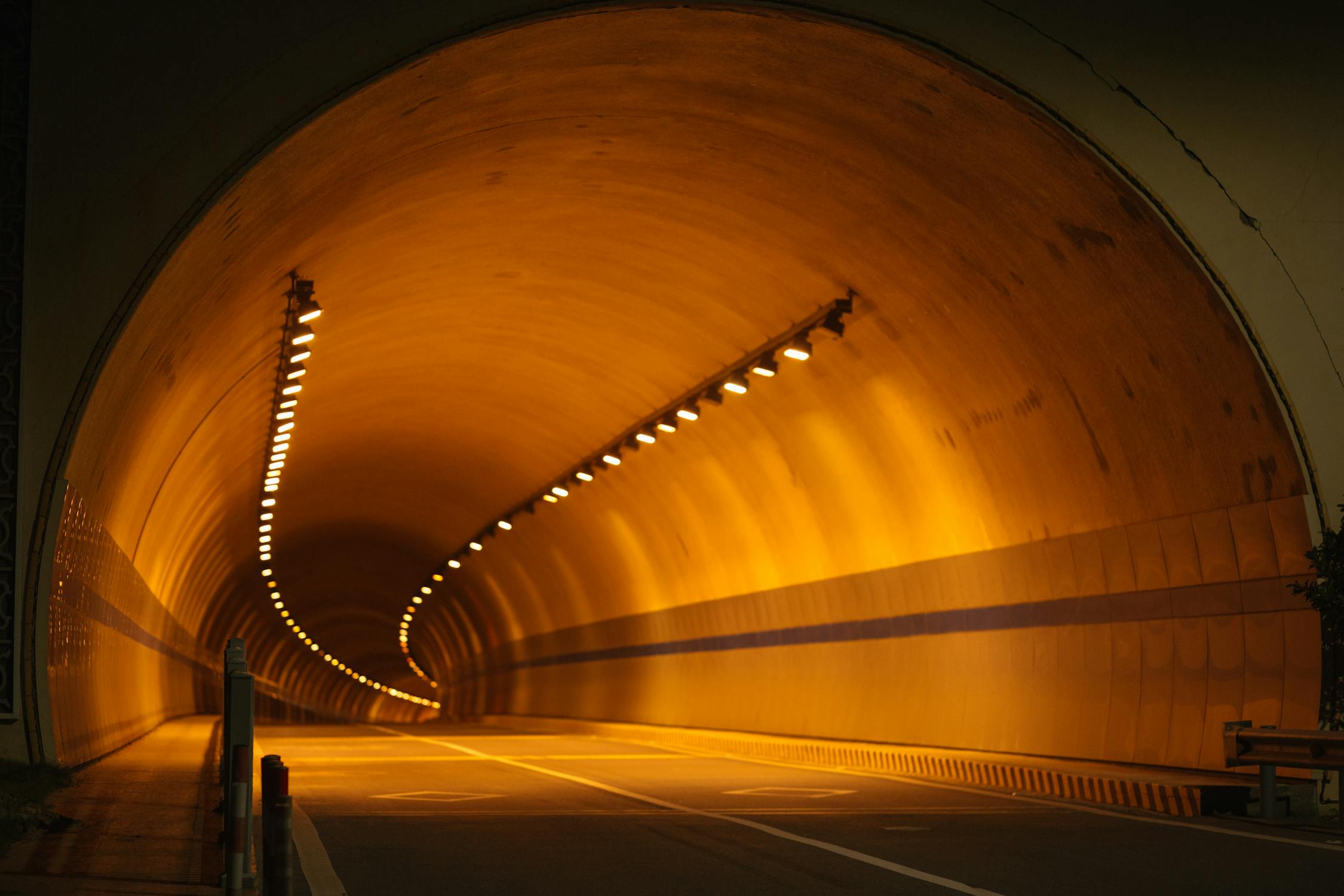
HPS produces light at a very narrow spectral band around 589nm (the characteristic orange-yellow colour visible in older tunnel photographs). CRI (Colour Rendering Index) for HPS is typically Ra 20 to 25. This is low enough to make colour discrimination genuinely difficult: road marking colours, vehicle colours, and hazard identification all depend on colour rendering that HPS simply cannot deliver.
LED tunnel fittings are specified at Ra 70 minimum in most current Australian tunnel specifications, with Ra 80 now increasingly common in new builds. This substantially improves colour discrimination for drivers and CCTV systems, and reduces detection distance for road hazards.
| Characteristic | HPS (Sodium Vapour) | Metal Halide | LED |
|---|---|---|---|
| CRI (colour rendering) | Ra 20 to 25 (very poor) | Ra 65 to 85 (moderate) | Ra 70 to 90+ (good to excellent) |
| Efficacy (lm/W) | 80 to 130 | 70 to 100 | 120 to 180+ |
| Rated lamp life (hours) | 18,000 to 24,000 | 12,000 to 20,000 | 50,000 to 100,000 |
| Warm-up and restrike | 3 to 5 min cold; 10 to 15 min hot restrike | 2 to 5 min cold; 10 to 20 min hot restrike | Instant (under 1 second) |
| Dimming capability | None (voltage reduction causes colour shift) | Limited (ballast-dependent) | Excellent (typically 10 to 100%) |
| Adaptive dimming (CIE 88) | Not feasible | Marginal | Standard in new Australian tunnels |
| Maintenance interval (24/7) | 2 to 3 years | 1.5 to 2.5 years | 6 to 12+ years |
| IP capability | IP65 typical | IP65 typical | IP65 to IP67 available |
| Emergency response (instant on) | No | No | Yes |
Adaptive dimming: the technology that changes the economics
Adaptive dimming systems use luminance sensors mounted at each tunnel portal to measure actual outdoor luminance in real time. The threshold zone luminance target is calculated from the current L20 measurement and the dimming system adjusts fitting output accordingly. On an overcast winter day in Melbourne, threshold zone fittings may run at 25 to 35 percent of installed capacity. At night, they may dim to 10 to 15 percent while still meeting the CIE 88 night-time threshold zone targets.
HPS cannot be usefully dimmed: reducing voltage below a threshold causes colour shift and lamp instability. LED dims cleanly from 100 percent to typically 10 to 15 percent with no colour shift and no restrike delay. This is the technology characteristic that finally makes dynamic tunnel lighting practical, and it is the primary reason that adaptive dimming has become standard in all new Australian tunnel projects since approximately 2015.
IP Ratings and Environmental Specification for Australian Tunnels
Tunnel environments are aggressive. Road fittings are exposed to diesel exhaust particulates, carbon monoxide, nitrogen oxides, vehicle-generated turbulence, cleaning agent overspray during wall washing operations, and in some Australian tunnels, significant humidity variation between summer and winter. Fitting specification must account for all of these.
| Rating | Minimum requirement | Notes for Australian tunnels |
|---|---|---|
| IP (ingress protection) | IP65 | IP66 recommended for wall washing zones. IP67 for any areas with drainage risk. Portal areas may require IP67 due to rain ingress. |
| IK (impact protection) | IK08 | IK10 preferred for fittings at vehicle height. High-speed vehicle wake turbulence generates significant mechanical stress. |
| Corrosion resistance | Grade 316 stainless fixings | Marine-grade stainless for all external hardware. Powder-coat finish on aluminium housings. Salt air relevant to coastal tunnels in Sydney and Brisbane. |
| Operating temperature | -10°C to +50°C | Australian summer ceiling temperatures in sealed threshold zones can exceed 45°C ambient. Driver specification must account for this in thermal management design. |
| Vibration resistance | IEC 60068-2-6 | Vehicle-induced vibration, particularly from heavy vehicles, is continuous in high-traffic tunnels. Fitting mounting systems and driver components must be rated accordingly. |
Specifying LED for a Tunnel Retrofit: What Engineers Need to Ask
Tunnel LED Specification Checklist
Counter-Beam Lighting: The Tunnel-Specific Technique
Standard road lighting directs light downward onto the road surface. Counter-beam lighting, used in threshold and transition zones of high-speed tunnels, directs a component of the light toward the approaching driver. The effect is to increase the apparent luminance of objects on the road surface as seen by the driver, improving target visibility in the critical adaptation zone without simply increasing total installed wattage.
The counter-beam technique was developed specifically for tunnel applications and is referenced in CIE 88 as the preferred approach for high-speed threshold zones. Modern LED tunnel fittings designed for counter-beam applications use asymmetric optics to achieve the required forward throw while maintaining the overall luminance uniformity targets for the zone. This is an area where fitting selection matters considerably. A standard symmetric LED fitting cannot deliver the optical performance required for a properly designed counter-beam threshold zone.
Carbon Monoxide Monitoring and Ventilation Integration
Australian road tunnels of any significant length operate carbon monoxide (CO) monitoring as a statutory requirement. In mechanically ventilated tunnels, the CO monitor output feeds the ventilation control system and may also affect lighting levels: some tunnel management systems dim interior zone lighting during ventilation events (as a proxy signal to drivers that conditions are abnormal). The lighting control system specification must account for these integration requirements.
Visibility measurement using laser forward-scatter sensors is used in longer tunnels to monitor smoke and particulate levels, which also feeds ventilation and (in incident response scenarios) lighting level changes. LED's instant-on characteristic (no warm-up delay) is important in these contexts: HPS emergency response lighting takes several minutes to reach full output after a cold start. LED reaches full output in under a second.
The Payback Calculation for Australian Tunnel Operators
Tunnel LED upgrade economics in Australia consistently show payback periods of 3 to 7 years when energy savings alone are counted, and 2 to 4 years when maintenance cost avoidance is included. The variation depends on tunnel length, traffic volume, existing fitting wattage, the state energy tariff, and how frequently the existing HPS fittings were requiring replacement.
The calculator at ledsavings.com.au is designed for commercial and industrial LED upgrades rather than tunnel-specific projects, but the underlying energy and payback calculations are applicable to any 24/7 industrial lighting scenario. For a preliminary energy saving estimate on tunnel interior zone fittings, use the industrial or warehouse fixture type with 8,760 annual operating hours. For full tunnel project economics including maintenance cost modelling, engage a specialist lighting engineer with tunnel experience.
New Builds Versus Retrofits: Different Constraints, Same Physics
New Australian tunnels built since approximately 2015 (NorthConnex, WestConnex, Legacy Way) have been LED-designed from the outset with adaptive dimming as standard. The design freedom is significant: counter-beam optics can be specified in the original tender, DALI-2 control wiring can be installed during construction, and maintenance access provisions can be built around LED's longer service life.
Retrofit projects in older tunnels face a different set of constraints. The existing conduit and wiring may not support addressable control. Fitting mounting centres were set for HPS photometrics and may not be optimal for LED optics. Traffic management budgets limit how many retrofit phases can be scheduled per year. These are engineering and project management problems rather than physics problems, but they significantly affect which LED products are suitable and how the upgrade is staged.
For retrofit work, the key specification decisions are: whether to maintain existing mounting positions or redesign the layout (significant cost difference); whether to upgrade to adaptive dimming control in the same project or install dim-to-a-set-point LED as an interim step; and whether the threshold zone counter-beam fittings can be adapted for the existing wiring infrastructure or require new cable runs.
Calculate energy savings for industrial and 24/7 applications
Use the LED Savings Calculator to model any high-hours commercial or industrial scenario. Enter 8,760 hours/year for a continuous-operation tunnel or industrial site.