The Standard: What AS/NZS 2293 Covers

Emergency and exit lighting in Australian buildings is governed by AS/NZS 2293, which has three parts. Part 1 covers system design, installation and operation. Part 2 covers inspection and maintenance. Part 3 covers the luminaires and exit signs themselves.

The National Construction Code (NCC, formerly BCA) references AS/NZS 2293 as the compliance pathway for emergency lighting in Class 2 through Class 9 buildings. That covers apartments, offices, shops, industrial buildings, hospitals, schools, hotels and aged care. If your building has a fire evacuation plan, it almost certainly needs compliant emergency lighting.

Important: AS/NZS 2293 compliance is not optional. Failure to maintain compliant emergency lighting can void your building's insurance, expose the building owner to liability in the event of an incident, and trigger rectification notices from state building regulators. It is not a box-tick โ€” it is a life safety system.

The Two Types of Emergency Luminaire

๐Ÿ”‹

Self-Contained

Battery inside each fitting. Most common in commercial buildings. Each unit is independent โ€” one failure doesn't take down others. Battery must be tested and replaced individually.

๐Ÿฆ

Central Battery

One battery bank feeds multiple luminaires via wiring. Common in hospitals, schools and large commercial. Single maintenance point. Lower per-luminaire cost at scale. LED suits it well (lower load).

๐Ÿ’ก

Maintained vs Non-Maintained

Maintained: lamp runs continuously (used in cinemas, theatres). Non-maintained: lamp only operates on mains failure. Most commercial buildings use non-maintained. Both have the same 90-minute requirement.

The 90-Minute Rule and What It Actually Means

AS/NZS 2293.1 requires emergency luminaires to operate at rated output for a minimum of 90 minutes after mains failure, then recharge to 90% capacity within 24 hours. That 90-minute figure comes from fire evacuation modelling โ€” it represents the time needed to evacuate a building during a fire event, with margin.

The required illuminance on the floor of an escape route is a minimum average of 1 lux, with a maximum-to-minimum uniformity ratio not exceeding 40:1. High-risk task areas (plant rooms, kitchens, areas with moving machinery) require higher levels: typically 10% of normal task illuminance or 15 lux, whichever is greater. Anti-panic areas (open spaces where occupants might panic without orientation lighting) require a minimum of 0.5 lux.

These are floor-level values. They are measured with a lux meter at ground level along the centreline of the escape route, not estimated from a photometric calculation. If your escape routes have changed since the original lighting layout was designed (new partitions, relocated doors, refurbished areas), your illuminance coverage may have changed with them.

Testing Requirements: What the Standard Requires

Test Type Frequency Method Who
Functional test Monthly Simulate mains failure, verify lamp operates for at least 30 seconds, restore power Licensed electrician or competent person (state-dependent)
Duration test Annual Full 90-minute discharge, verify lamp maintains output throughout, record result, allow full recharge Licensed electrician in all states
Illuminance check After any fitout change Lux meter survey of all escape routes Licensed electrician or lighting designer
Visual inspection Monthly Check all lamps operating, signs illuminated, no physical damage Facility manager or competent person

Test records must be retained for a minimum of three years and made available to building inspectors on request. The records must include the date, the name of the person who conducted the test, the result for each luminaire, and any remedial action taken.

The Green Light Trap

This is the most common compliance failure in Australian commercial buildings, and it's entirely invisible until someone does the annual discharge test.

Every self-contained emergency fitting has a small indicator LED on the face. Green means the charger circuit is working and drawing current. It does not mean the battery can sustain a load for 90 minutes. A battery can accept a trickle charge, show a green indicator, and deliver less than 10 minutes of actual runtime โ€” or nothing at all โ€” because its cells have degraded past the point of holding useful charge.

NiCd battery life is 4 to 5 years. SLA (sealed lead acid) is 3 to 4 years. LiFePO4 (lithium iron phosphate, common in newer LED units) is 8 to 10 years. If your building has emergency fittings older than 5 years and the batteries have never been replaced, you should assume they have failed the 90-minute requirement until proven otherwise. The green light is not proof.

The annual 90-minute duration test exists specifically to catch this. Buildings that skip the annual test, or record results without actually running the discharge, are operating outside the standard and carrying genuine liability.

Where LED Changes the Equation

The shift to LED in emergency lighting is not just about energy saving. It changes the maintenance profile in ways that matter for compliance.

Lower wattage, smaller battery, same 90 minutes

A traditional self-contained fluorescent emergency fitting uses a T5 lamp drawing around 8 watts during emergency operation. An equivalent LED fitting draws 2 to 3 watts for the same light output. Because the battery only needs to sustain a 2W load rather than an 8W load, a physically smaller (and cheaper) battery can meet the 90-minute requirement. In central battery systems, the entire battery bank can be significantly downsized when luminaires are converted to LED.

Battery Size Comparison

A 50-luminaire central battery system with 8W fluorescent emergency lamps needs to sustain 400W for 90 minutes โ€” roughly 600 Wh of usable capacity.

Convert to 2W LED luminaires and the load drops to 100W for 90 minutes โ€” roughly 150 Wh of usable capacity.

That is a 75% reduction in battery bank size. At central battery system replacement cost, the battery saving alone can offset a significant portion of the LED conversion cost.

No lamp failures

In a fluorescent self-contained fitting, there are two failure modes: battery failure and lamp failure. T5 emergency lamps have a rated life of around 8,000 hours under continuous maintained operation, but in non-maintained fittings they can fail unpredictably from cold-start cycling. LED sources in a properly rated fitting carry a 50,000-hour rated life and have no filament or gas to degrade. One of the two main failure modes is essentially eliminated.

Self-testing luminaires (Category D)

AS/NZS 2293.1 allows for self-monitoring luminaires (referred to in the standard as Category D or automatic test units). These fittings contain a microcontroller that automatically performs the monthly functional test and records the result internally. Some models communicate results via Bluetooth or a wired bus to a building management system.

Self-testing LED emergency fittings do not eliminate the requirement for an annual 90-minute duration test, and that test still requires a licensed electrician to attend, run the discharge and sign the log. But they do substantially reduce the monthly walk-through labour: instead of an electrician manually pressing and holding each fitting for 30 seconds and recording the result on a clipboard, the data already exists in the fitting's memory. In a building with 200 emergency fittings, that monthly labour saving is material.

Exit Signs: Different Rules, Same Neglect

Emergency luminaires (the dome or batten fittings that illuminate escape routes) and exit signs are separate products with separate requirements, but they share the same compliance framework and the same tendency to be ignored until an audit.

Pictogram, not text

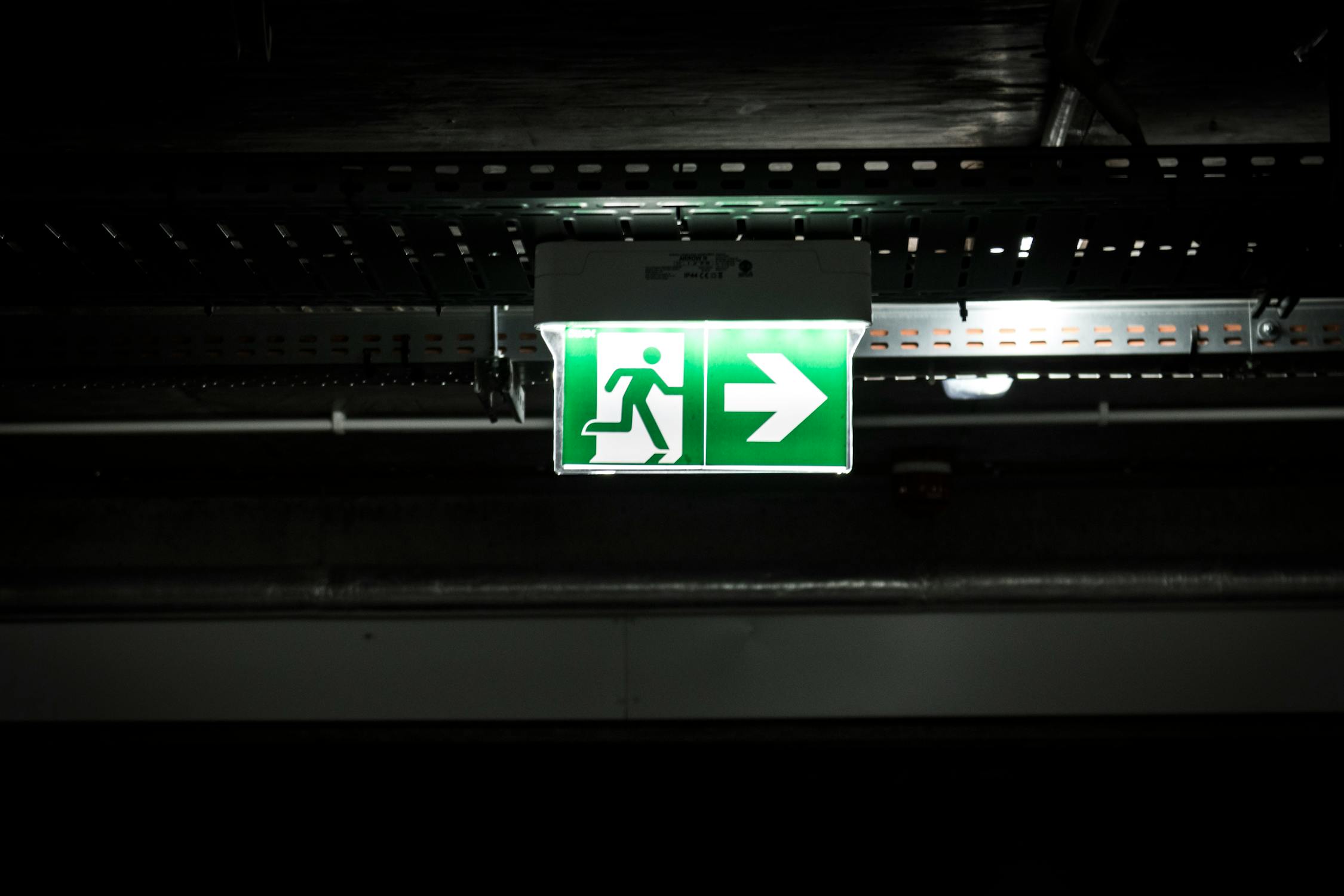
AS/NZS 2293.3 requires exit signs to use the ISO 7010 E001 pictogram: the white running figure on green background with a directional arrow. The old "EXIT" text in red or green is not compliant for new installations or significant refurbishments. Many buildings still have text-based exit signs in areas that have been refurbished โ€” those areas are technically non-compliant.

The legibility distance requirement means the pictogram must be readable from a specified distance based on the sign's luminance and symbol height. LED exit signs are far better at maintaining uniform luminance across the face than fluorescent-backlit signs, where tubes run behind diffuser panels and create visible hotspots. A dim or patchy exit sign face is a compliance failure even if the lamp is technically operating.

Power consumption

Exit signs are maintained luminaires: they run 24 hours a day, 365 days a year. An old fluorescent exit sign draws 8 to 20 watts depending on size and lamp count. An LED exit sign draws 1 to 3 watts. On a building with 60 exit signs running continuously, that difference is roughly 5,000 kWh per year โ€” around $1,500 to $2,000 in electricity at commercial rates, before any VEU or ESS rebate entitlements.

Common Compliance Failures (What Auditors Actually Find)

Most Common

Batteries past end of life. Units fail the 90-minute duration test. Green indicator light still showing.

Very Common

No annual test records. Building has never had a formal 90-minute discharge test conducted and logged.

Common

Changed escape routes after fitout. New partitions block luminaire coverage. Illuminance falls below 1 lux on the centreline.

Common

Failed charger board. Unit draws no charge current. Battery has been slowly discharging for months. Green light may still show on a failing charger.

Moderate

Text-based "EXIT" signs in refurbished areas. Non-compliant for new work under current standard.

Moderate

One face of a twin-face exit sign failed. Looks fine from one direction. Auditor checks both faces.

Less Common

Luminaire spacing too wide after ceiling reconfiguration. Spacing calculations assume clear sightlines that no longer exist.

Less Common

High-risk task areas (switchrooms, plant rooms) lit only to escape route standard. Need 15 lux or 10% of task illuminance.

LED Conversion: Self-Contained Replacement vs Kit vs Central Battery

There are three paths to LED in an existing emergency lighting system, and which is right depends on the age of your infrastructure and the size of the building.

Full replacement with LED self-contained units is the cleanest option for most commercial buildings. New units come with LED source, LiFePO4 battery, self-test function and a 5-year warranty as standard from reputable suppliers. The old fittings are removed entirely. Cost is higher upfront but removes all uncertainty about the existing hardware.

LED conversion kits replace the lamp, driver and sometimes the battery inside an existing batten-style fitting. Cost is lower, but you are retaining the existing charger board and battery case, which may themselves be near end of life. Check that the existing charger is compatible with the LED module's charge requirements before specifying kits.

Central battery system replacement makes sense when the battery bank itself is due for replacement. If you have a 10-year-old central battery system with failing batteries, replacing the bank with a new LED-rated unit and converting the luminaires simultaneously gives you the battery size saving described above and resets the entire system's maintenance clock.

Rebate eligibility: LED emergency lighting upgrades can be eligible under the Victorian Energy Upgrades (VEU) scheme and the NSW Energy Savings Scheme (ESS), provided the installation meets the scheme's technical requirements. Exit sign replacements are also commonly eligible. Check with an accredited installer before specifying โ€” the certificate value can be substantial on a large-building upgrade.

Practical Compliance Checklist

Emergency Lighting Compliance Checklist

โœ“ Annual 90-minute duration test completed and logged within the last 12 months, signed by a licensed electrician
โœ“ Monthly functional test records up to date (minimum 3 years of records retained)
โœ“ All battery ages known. Any NiCd or SLA batteries older than 4 years scheduled for replacement
โœ“ Escape route layout matches current building layout (no new walls, relocated doors or removed luminaires since last illuminance check)
โœ“ All exit signs illuminated on both faces, running man pictogram correct, no text-only signs in areas of new work
โœ“ High-risk task areas (switchrooms, plant rooms, kitchens) identified and confirmed to meet 15 lux or 10% task illuminance requirement
โœ“ Any self-test luminaires confirmed to be logging results and alerts reviewed regularly
โœ“ Compliance documentation filed and accessible on-site for building inspector review

The Bottom Line

Emergency and exit lighting is the one system in a building that only matters when everything else has gone wrong. The building is dark, people are stressed, the exit route needs to be obvious and the light needs to stay on for 90 minutes. That is not the moment to discover the battery failed three years ago.

LED technology improves the situation: lower wattage extends battery runtime margin, longer source life removes one failure mode, and self-test units automate the monthly check. But none of that replaces the annual discharge test and the honest record-keeping that AS/NZS 2293 requires.

If your building has fluorescent self-contained emergency fittings older than 5 years and you can't put your hands on 3 years of annual test records, that is where to start. Everything else is secondary.