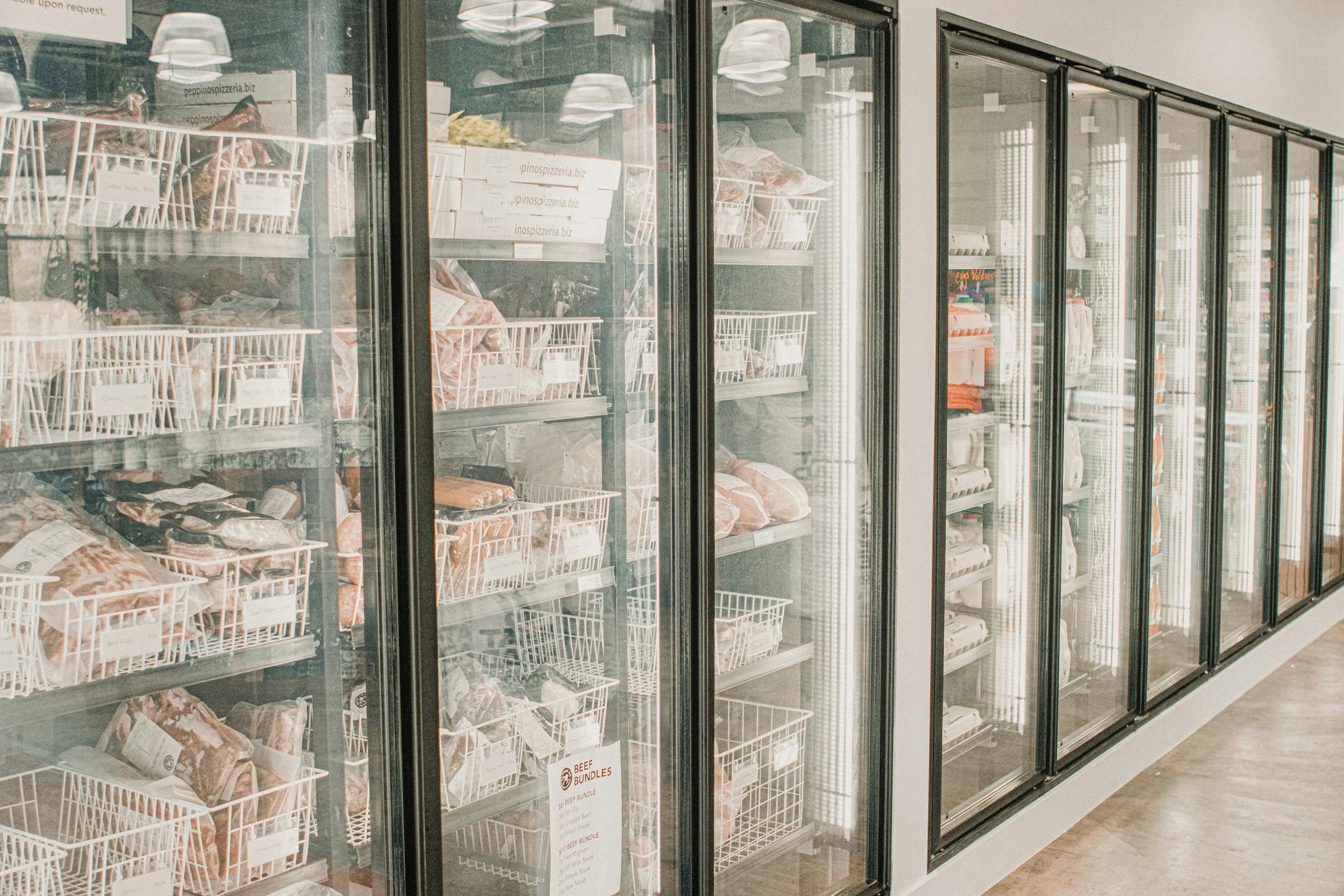
What happens to existing technology in the cold
Standard T8 fluorescent lamps run on a mercury vapour discharge. Below about 10°C, mercury starts condensing on the tube wall, reducing vapour pressure and dropping lumen output noticeably. Below 0°C, standard T8 lamps struggle to start at all without cold-weather ballasts. At -25°C (a typical blast freeze or long-term frozen storage temperature), standard fluorescent is functionally useless without expensive specialised cold-weather versions, and even those deliver reduced output and slow, flickery starts.
Metal halide and high pressure sodium fare no better. Both require a warm-up period of five to ten minutes from cold start before reaching full output. After a power interruption, the hot restrike time for metal halide is fifteen to twenty minutes: the lamp will not re-light until it has cooled sufficiently. In a cold store where a power event or circuit trip cuts the lights, staff are working in near-darkness for up to twenty minutes before MH lighting recovers. That is a food safety and workplace safety issue, not just an inconvenience.
The result in many Australian cold stores is that lights are left on permanently, because the warm-up and start penalties make switching them off impractical. That burns energy continuously, adds to refrigeration load around the clock, and shortens lamp life through thermal cycling. It is a poor workaround driven by the technology's limitations rather than the facility's actual needs.
Why LEDs perform better in cold, not worse
LED performance is governed primarily by junction temperature: the temperature at the semiconductor junction inside the chip. Lower junction temperature produces higher lumen output, better colour stability and longer rated life. In a standard warehouse at 25°C ambient, a quality LED fitting runs its junction at perhaps 60–70°C. In a -25°C freezer environment, the same fitting runs significantly cooler, and output can increase by 10 to 15% compared to its nominal rated value.
The cold store advantage: A 150W LED high bay rated at 22,500 lumens at 25°C ambient may deliver 24,000 to 25,000 lumens in a -25°C freezer. Lumen output goes up. LED lifespan goes up. Energy consumption is unchanged. This is the inverse of every other technology used in cold stores, and it is why LED pays back faster in this application than almost any other.
Instant start is the other critical operational advantage. LED reaches full output in milliseconds regardless of ambient temperature. Motion-activated dimming becomes genuinely useful: dim the lights to 20% when no staff are present, ramp to full output the moment a sensor detects movement. In a freezer that may be occupied for only two or three hours of a twelve-hour operating period, that dimming strategy alone can cut lighting energy consumption by 60 to 70%.
The compounding refrigeration saving
In any refrigerated space, heat is the enemy. Every watt of energy consumed by a lighting fitting produces a watt of heat that the refrigeration system must then remove. That means the true energy cost of a lighting fitting in a cold store is the fitting's own consumption plus the additional compressor load required to extract its heat output.
Real energy saving in cold storage: 100 × 70W T8 fluorescent to 30W LED batten
The refrigeration load multiplier varies by system efficiency (COP) and room temperature, but in most practical cold store scenarios it adds 30 to 50% to the effective energy saving compared to a naive wattage comparison. This is a genuine and often overlooked benefit of LED in refrigerated environments, and it should be included in any ROI calculation for this application.
Temperature zones and what they require
These zone boundaries matter for specification because a fitting that performs reliably at -10°C may fail at -25°C due to driver electronics reaching their lower operating limit. Always check the driver's rated minimum operating temperature, not just the luminaire body. Many LED fittings marketed as "cold store rated" specify the housing to -20°C but use drivers with a -10°C lower limit. The driver is the failure point.
IP ratings: what you need and why
The Ingress Protection (IP) rating system has two digits. The first covers solid particle ingress, the second covers liquid. In cold storage, the liquid digit is the critical one: condensation, wash-down water and steam cleaning are all potential entry points for a poorly sealed fitting.
| Rating | Protection level | Recommended for |
|---|---|---|
| IP65 | Dust-tight. Protected against water jets from any direction. | Cool rooms (0–10°C), general cold store areas, low-pressure cleaning. Minimum for cold store |
| IP66 | Dust-tight. Protected against powerful water jets. | Freezer rooms (-18°C and below), areas subject to high-pressure hose-down cleaning. Recommended for freezers |
| IP67 | Dust-tight. Protected against temporary immersion up to 1 metre. | Very wet environments, areas with floor flooding risk, seafood handling floors. Recommended for wet processing |
| IP69K | Dust-tight. Protected against high-pressure, high-temperature steam wash-down. | Abattoirs, food processing lines, dairy processing, anywhere subject to steam cleaning at 80°C+. Required for intensive washdown |
IP ratings are tested under controlled conditions. Real-world performance depends on gasket material as much as the rating itself. Foam gaskets degrade in cold environments and with repeated chemical cleaning. Specify silicone gaskets. They remain flexible at -40°C and resist the caustic cleaning agents used in food environments.
Condensation: the failure mode nobody mentions in the brochure
When a -25°C freezer door opens into a +20°C loading dock, the temperature differential across the doorway is 45°C. Warm, humid air floods in. Any surface below the dew point immediately attracts condensation. A fitting with a compromised seal, a micro-crack in a diffuser, or a foam gasket that has hardened and pulled away from the housing will ingest that moisture over thousands of door cycles.
Water inside a luminaire housing does not announce itself immediately. It accumulates, causes gradual corrosion of driver components, and eventually produces a failure six to eighteen months after the seal first compromised. The failure mode looks like random driver failure or premature LED death, and it is often misattributed to product quality rather than ingress.
The engineering solution is twofold: sealed construction with silicone gaskets as described above, and anti-condensation heaters in fittings designed for the most demanding environments. Some premium cold-store LED fittings include a small resistance heater in the housing that activates when the fitting is switched off, keeping the internal temperature above the dew point and preventing condensation formation inside the sealed enclosure. For blast freeze and deep freeze applications, this feature is worth the additional cost.
Colour rendering and food safety
This is one application where the general recommendation of 3000K for commercial and industrial LED does not automatically apply. Cold storage facilities that include quality inspection, grading, or visual assessment of food products require high colour rendering to reliably detect defects: bruising on fruit, discolouration in meat, mould on dairy, fat content in seafood.
For general frozen storage, 4000K at CRI Ra70 is adequate and common. For quality inspection stations, picking lines where colour accuracy aids error detection, and any area where product visual assessment takes place, specify 4000K to 5000K at CRI Ra90 or higher. The higher colour rendering genuinely affects inspection outcomes and is worth specifying explicitly rather than accepting the base product offer.
NSF certification: The NSF/ANSI 2 standard covers equipment used in direct food contact or food handling environments. In Australian abattoirs, food processing facilities and commercial kitchens, NSF-certified or equivalent fittings are increasingly specified or required by food safety auditors. NSF-certified luminaires use materials that resist bacterial growth, have no exposed fasteners that could harbour contamination, and use shatterproof diffusers (polycarbonate or safety glass) to prevent glass contamination of product in a breakage event. If your facility is subject to third-party food safety audits, confirm certification requirements before purchasing.
Impact resistance: IK ratings and forklift reality
Cold stores with forklift traffic need impact-rated fittings. The IK rating system covers mechanical impact resistance. IK08 withstands 5 joules of impact (roughly equivalent to a 1.7kg mass dropped from 30cm). IK10 withstands 20 joules. For any aisle where forklifts or pallet jacks operate, IK08 is the minimum and IK10 is preferred. Polycarbonate diffusers are mandatory: glass shatters into food product and creates a contamination and personnel safety incident that no one wants to explain to a food safety auditor.
Smart controls in cold storage
The combination of LED's instant start and its cost profile makes motion-activated dimming economically compelling in cold storage in a way it never was with fluorescent. A freezer room that is accessed for picking three times per shift can run at 20% output between picks and ramp to 100% within milliseconds of a motion sensor triggering. Across a ten-hour shift with three hours of actual occupancy, that dimming profile cuts lighting energy by roughly 65%.
DALI (Digital Addressable Lighting Interface) or 0-10V dimming controls integrate cleanly with cold store management systems. Daylight harvesting is not relevant inside a sealed cold store, but occupancy-linked zoning, where different zones dim independently based on forklift sensor or push-button input, is practical and pays back quickly in large facilities.
The specification checklist
- Driver rated temperature: confirm minimum operating temp, not just housingSpecify driver operating range to at least 10°C below your lowest ambient temperature. For -25°C freezers, require a driver rated to -35°C or lower. This is the most common point of failure in cold store LED installations.
- IP rating: IP65 minimum, IP66 for freezers, IP69K for washdown areasConfirm gasket material is silicone, not foam. Ask for IP test certificates, not just catalogue claims.
- IK10 impact rating and polycarbonate diffuser for forklift areasNon-negotiable in any aisle where powered industrial vehicles operate. Glass diffusers in food environments are a food safety liability.
- CRI Ra90 at inspection and grading stations; Ra70+ for general storageSpecify CCT at 4000K for both. For deep freeze and general storage only, 3000K is acceptable. For food inspection, 4000K Ra90 is the right specification.
- Motion-activated dimming: specify 0-10V or DALI, dim to 20% minimumConfirm the dimming driver is rated to the same minimum temperature as the main driver. Some fitting packages have full-spec main drivers with lower-rated dimming modules.
- Anti-condensation heater for blast freeze and deep freeze (−18°C and below)Worthwhile in the highest thermal shock environments. Not required in cool rooms or standard cold stores with good door sealing.
- NSF/ANSI 2 or equivalent certification for food processing and abattoir areasConfirm your food safety auditor's requirements before specifying. Not all food environments require this, but knowing the answer before purchase is better than finding out during an audit.
- Warranty: 5 years minimum, on-site, covering the full operating temperature rangeA 5-year warranty that excludes temperatures below -10°C is not a 5-year warranty for a -25°C freezer installation. Read the exclusions.
Technology comparison at a glance
| Factor | T8 Fluorescent | Metal Halide | LED (cold-rated) |
|---|---|---|---|
| Start time at -25°C | Fails or very slow | 10 min warm-up | Instant |
| Restrike after power loss | 1–2 min | 15–20 min | Instant |
| Output at -25°C vs rated | 40–60% of rated | Reduced | 105–115% of rated |
| Efficacy (lm/W) | 80–95 | 80–110 | 130–180 |
| Compatible with dimming | No (cold) | No | Yes (0-10V / DALI) |
| Heat output (adds to refrigeration load) | High | High | Low |
| Lifespan at -25°C | Reduced | Reduced | Extended |
| IP65+ rated products available | Limited | Limited | Wide range |
| Suitable for food safety environments | Marginal | No | Yes (with correct spec) |
 Calculate your cold store LED saving
Enter your existing lamp wattage, number of fittings and operating hours to see the energy saving and payback period. For cold store applications, the real saving is 30 to 50% higher than the lighting wattage reduction alone due to reduced refrigeration load.
Open the LED Savings Calculator