 LED Savings
We've covered what happened to NSW's ESS commercial lighting certificates, and why SA's REPS scheme gives the fastest LED payback in the country. Victoria is the obvious gap: VEU is the oldest and largest of Australia's three big lighting rebate schemes, and it just went through more change in 2026 than NSW and SA combined. The Act that creates it is being renamed. The targets that drive it were cut. And the rules on what indoor lighting actually qualifies quietly narrowed years ago, in a way most business owners still don't know about.
If you're a Victorian business and someone has quoted you a VEU-subsidised LED upgrade recently, there's a reasonable chance the activity they're claiming it under doesn't cover what you think it covers. Here's what's actually still eligible, what changed, and what to check before you sign.
The one thing most VIC lighting quotes get wrong in 2026
Victoria's own government guidance for businesses states this plainly, and it's worth quoting directly rather than summarising: "Businesses may be eligible for indoor lighting upgrades if their existing lights are fluorescent. Incentives to replace other types of lighting have now ended."[1]
That single sentence is the whole story for most warehouse and office upgrades. If your existing indoor fittings are metal halide, halogen, or anything other than fluorescent, a straight lamp-for-lamp LED swap inside the building no longer earns a VEU rebate. This isn't a new 2026 change, the incentive for non-fluorescent indoor lighting was removed back in 2023, but it's still routinely missed by businesses assuming VEU works the way it used to, or the way NSW ESS and SA REPS still work for any lighting technology.
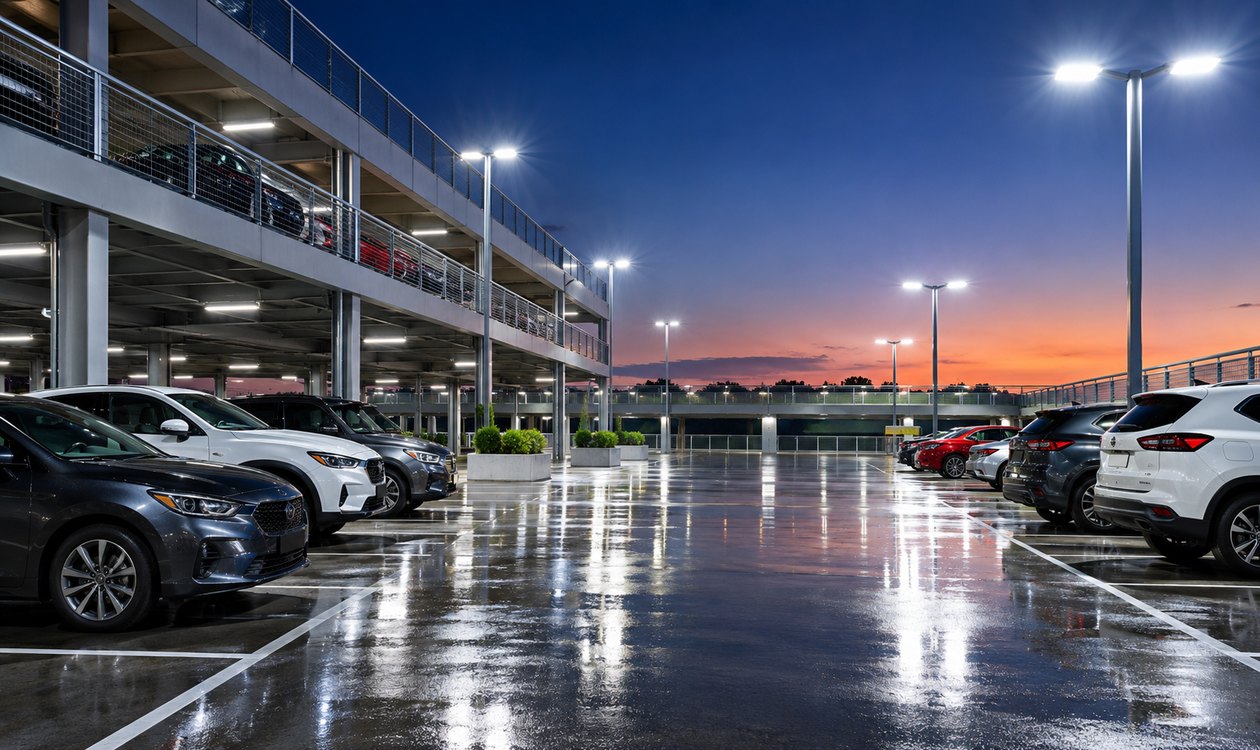
What this means in practice: a 400W metal halide high bay inside your warehouse does not qualify for a VEU rebate when swapped for an LED high bay. The same warehouse's open-air loading dock or car park lighting, running the same metal halide technology, very likely still does. Which activity number applies changes the answer completely.
Three activities, three very different eligibility rules
VEU splits commercial lighting into three separate activities, each with its own scope and its own current rules.[2]
Activity 34: Building based lighting upgrades
Anything inside a structure covered by the Building Code of Australia: offices, warehouses, retail spaces, undercover car parks. This is the activity that was narrowed to fluorescent-only replacements. The current Building Based Lighting Upgrade Activity Guide is Version 3.0, dated 18 March 2026, if your installer is quoting from an older version, ask why.
Activity 35: Non-building based lighting upgrades
Lighting in places that aren't inside a BCA-covered structure: private roads, open-air car parks, sports fields, other outdoor commercial space. This is where metal halide and other non-fluorescent technologies remain broadly eligible. Current guide: Version 2.8, 30 June 2026.
Activity 27: Public lighting upgrades
Street lighting and public lighting owned by a distribution company, council or road authority. Not something an individual business can claim directly, but relevant if you're a council or you manage public realm lighting on a authority's behalf. Current guide: Version 2.5, 30 June 2026.
Which activity actually applies to your fittings?
What the discount actually looks like
Victoria's own published indicative discount figures give a real sense of scale, these are government numbers, not installer marketing:[1]
Indicative VEU discounts (DEECA published figures)
Notice the pattern: the fluorescent indoor example (Activity 34) earns the smallest discount per fitting of the three. The open-air car park example (Activity 35) earns roughly 2.5 times as much per fitting, and it's precisely the category where non-fluorescent technology is still allowed. Street lighting (Activity 27) scales with volume but isn't something a business claims directly.
Lighting controls just got narrower too
On 30 June 2026, the Essential Services Commission updated Tables 27.7 and 35.7 in the VEU Specifications to clarify exactly which lighting control devices are eligible for Activity 27 (public lighting) and Activity 35 (non-building based lighting). The answer: only upgrades paired with programmable dimmers and occupancy sensors count.[3]
This is a clarification, not an expansion. If an installer proposes a different control type, a basic time switch, a daylight sensor on its own, something bundled as "smart lighting" without specifying programmable dimming or occupancy sensing, confirm in writing that it falls within Tables 27.7/35.7 before the job proceeds. A control device that doesn't match the specified combinations won't support a valid VEEC claim for that component of the job.
Why your rebate might be smaller than a mate's from 2024
The Victorian Government set emissions reduction targets of 4.4 million Victorian Energy Efficiency Certificates (VEECs) for 2026 and 4.6 million for 2027, both lower than 2025 levels. Around 6 million VEECs are still expected to be created each year, maintaining a healthy certificate surplus, but lower targets generally mean softer VEEC prices.[4] DEECA's own guidance acknowledges this directly: modelling suggests VEEC prices for 2026 and 2027 will decrease from recent years.
Retailers who fall short of their obligation pay a shortfall penalty, raised to $100 per VEEC to keep the incentive to buy certificates rather than cop the fine.[4] That penalty is the actual mechanism forcing retailers to fund your upgrade in the first place, same structure as NSW ESS and SA REPS, different number.
What this means for your upgrade
A VEU-subsidised quote in 2026 is likely to carry a smaller certificate value than the same job would have in 2023 or 2024. That doesn't mean the upgrade is a worse idea, the underlying electricity saving hasn't changed, it means the discount shouldn't be the entire basis for the decision. Run the energy saving numbers on their own merits first.
The bigger change: VEET becomes VEU, for real this time
The Act that creates the whole scheme, the Victorian Energy Efficiency Target Act 2007, is being formally renamed the Victorian Energy Upgrades Target Act, via the Energy and Resources Legislation Amendment (VEET Strategic Review and Other Matters) Act 2026, which has now received Royal Assent.[5] It's a housekeeping change on paper, the program has gone by "VEU" in everyday use for years, but it closes out a two-year, $5.9 million strategic review led by Solar Victoria within DEECA.
Separately, a 2025 Act already extended the program's end date from 2030 out to 2045, aligning it with Victoria's net zero target. The 2026 Act adds consumer protections that matter if you're dealing with a doorknocking or cold-calling VEU "provider": telemarketing and doorknocking practices tied to VEU signups have been restricted, scheme participants now face mandatory training requirements, and the ESC's compliance and enforcement powers have been strengthened.[5] If you've ever had a dodgy VEU pitch at the front counter, that's precisely the behaviour these reforms target.
What to actually do if you're running a Victorian business
- Work out whether your fittings are "inside" or "outside" the building envelope first. That single distinction decides whether fluorescent-only rules (Activity 34) or broader eligibility (Activity 35) applies.
- If you're being quoted a non-fluorescent indoor swap with VEU included, ask which activity number is being used. If the answer isn't a clear Activity 35 justification (i.e. the space genuinely isn't BCA-covered), the certificate claim may not be valid.
- If lighting controls are part of the quote for an outdoor or non-building job, confirm the control type matches Tables 27.7 or 35.7, programmable dimmer or occupancy sensor, not a generic "smart control" claim.
- Check the activity guide version your installer is working from. Current versions: Activity 34 v3.0 (18 March 2026), Activity 35 v2.8 and Activity 27 v2.5 (both 30 June 2026). An installer quoting from a materially older guide may be working off superseded rules.
- Treat the VEU discount as a bonus on a sound investment, not the investment case itself. With 2026/2027 VEEC prices expected to soften, the certificate value is likely smaller than in previous years. Run the electricity saving on its own numbers.
Multiple tenancies or recently changed hands? As with REPS in SA, check whether a previous occupant has already claimed a VEU activity at your address before assuming you're starting from a clean slate. An accredited provider can check this for you as part of a site assessment, which is normally free.
The bottom line
VEU hasn't gone away, and it remains the largest energy efficiency program of its kind in the country. But "VEU covers LED lighting" is no longer a complete sentence for a Victorian business. It covers fluorescent-to-LED indoors, it covers a much broader range of technologies outdoors and in non-building spaces, and as of mid-2026 it's specific about exactly which lighting controls qualify. Know which activity your job sits under before you sign, and treat the rebate as what it is: a useful discount on an upgrade that pays for itself either way.
See your VIC numbers without assuming a rebate
Our free calculator uses real Victorian commercial tariffs and lumen-based wattage comparisons, so you can see the electricity saving on its own merits first.