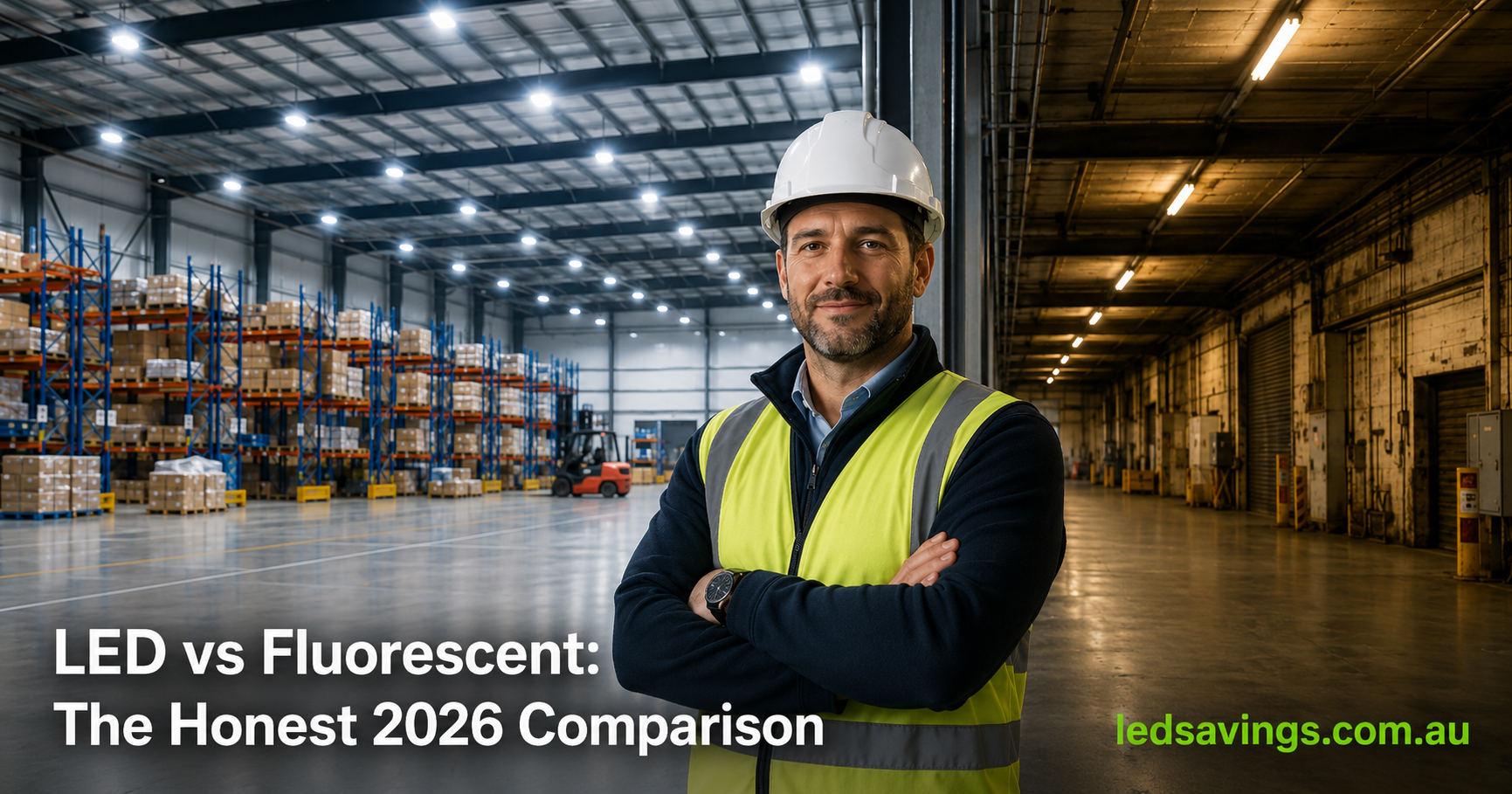
LED vs Fluorescent: The Honest 2026 Comparison for Australian Commercial Spaces
Millions of square metres of Australian commercial space still runs on T8 fluorescent. Warehouses, offices, schools, hospitals, retail strip shops, aged care facilities. The tubes work, the ballasts mostly work, and nobody has pulled the trigger on an upgrade because the decision feels complicated or the budget never quite lines up.
This article gives you the actual numbers so the decision stops feeling complicated. Not LED marketing numbers. Not fluorescent industry defensiveness. The real system wattage, the real lumen output over time, the real maintenance cost, and the cases where sticking with fluorescent is still a defensible call in 2026.
There are a few of those. Not many.
The headline numbers
| Parameter | T8 Fluorescent (36W) | LED Replacement (18W) | Verdict |
|---|---|---|---|
| System wattage (tube + ballast) | 46–48W (magnetic) / 40–42W (electronic) | 18–20W | LED by 50–60% |
| Initial lumen output | ~3,100 lm (new tube) | ~2,000–2,400 lm (budget) / 2,800–3,200 lm (quality) | Draw (quality-dependent) |
| Lumen output at 10,000 hrs | ~1,800 lm (58% of initial) | ~2,600 lm (L80: 80% maintained) | LED by 44% |
| Efficacy (system lm/W) | 65–75 lm/W | 100–140 lm/W | LED by 40–90% |
| Rated life | 10,000–20,000 hours (tube only) | 50,000–100,000 hours | LED by 3–5× |
| CRI (colour rendering) | Ra 70–85 (typical T8) | Ra 80–95 (product-dependent) | LED equal or better |
| Warm-up time | 30 sec–3 min to full output | Instant | LED |
| Cold temperature performance | Significant drop below 10°C; near zero at −10°C | Rated to −20°C to −40°C (commercial product) | LED (critical for cool rooms) |
| Flicker (magnetic ballast) | 100Hz (visible to some; stroboscopic hazard near machinery) | <1% at full output (quality driver) | LED |
| Flicker (electronic ballast) | 20–40kHz (not visible) | <1% at full output | Draw |
| Mercury content | 3–5mg per tube (regulated disposal) | None | LED |
| Dimmable | Requires dimmable ballast (extra cost) | Yes (with dimmable driver; specify at purchase) | LED |
| Upfront cost per fitting | $5–12 (tube replacement only) | $15–60 (tube) / $40–120 (panel/batten) | Fluorescent |
| Maintenance cost (10 yr) | High (2–3 relamping cycles + ballast failures) | Near zero (no relamping in 10 yr at 12 hr/day) | LED by large margin |
| Disposal cost | Regulated (mercury); Lamp Recycle program; $0.30–0.80 per tube | E-waste (general recycling); lower cost | LED |
The number most quotes get wrong: system wattage
A 36W T8 fluorescent tube does not consume 36 watts. The ballast that drives it consumes additional power. A magnetic ballast adds 10–12W. An electronic ballast adds 4–6W. The system wattage is what your energy bill reflects.
⚠ T8 Fluorescent (magnetic ballast)
✓ LED Replacement (quality 18W)
For a 100-fitting warehouse running 3,000 hours per year on 30c/kWh commercial tariff, that is $2,520 per year in energy savings from switching to LED. Before maintenance costs are factored in.
⚠ The electronic ballast trap. Buildings with newer electronic ballasts save less on energy than those with magnetic ballasts, because electronic ballasts are already efficient. The saving over an electronic ballast installation is typically 40–50% rather than 60%. That is still substantial, but the payback period is longer. Make sure your quote is based on the actual ballast type in your building, not a generic assumption.
What fluorescent lumen output actually looks like over time
This is the part of the comparison that rarely appears in supplier quotes, because it makes fluorescent look considerably worse than the spec sheet suggests.
A new T8 tube produces roughly 3,100 lumens. At the end of its rated life (around 15,000 hours for a quality T8), it is producing closer to 1,700–1,900 lumens. That is a 40% drop in light output from the same fitting, drawing the same power, on the same electricity bill.
LED degrades far more slowly and far more predictably. An L80-rated LED (the industry standard measurement) maintains 80% of its original output at the rated hour mark, typically 50,000 hours.
The practical consequence: a warehouse that measured 320 lux at installation with new T8 tubes will measure around 180 lux from those same fittings at the end of their service life. That is below the AS/NZS 1680 requirement for active picking areas. The space is non-compliant and nobody noticed because the degradation happened gradually.
LED degrades slowly enough that a well-specified installation remains compliant across the full maintenance cycle without relamping. This is why energy efficiency schemes (VEU in Victoria, REPS in South Australia) require maintained illuminance verification rather than just initial lux readings.
The real cost of maintaining a fluorescent installation
Tube cost is the obvious expense. Ballast failure is the one that kills the budget.
50-fitting commercial office, 3,000 hrs/yr (electronic ballast installation)
The LED installation cost for 50 office fittings (panels or battens, supply and install) typically runs $3,500–$7,000 depending on fitting type and access. Against a 5-year fluorescent running cost of $13,485, a $6,000 LED retrofit pays back in under 3 years on this scenario and keeps saving for the next 10–15 years without relamping.
CRI: the quality-of-light comparison
Standard T8 fluorescent tubes sit at Ra 70–80. Better "triphosphor" T8 tubes reach Ra 85. This is adequate for warehousing and general industrial work, but it is below what AS/NZS 1680 recommends for offices (Ra 80 minimum), retail (Ra 80–90), and colour-critical tasks (Ra 90+).
Many commercial buildings installed fluorescent tubes at Ra 70 decades ago and have simply relamped with the same spec ever since. The lighting works. It is just not as good as it should be under the current standard.
LED products at Ra 80 are the commercial baseline and cost no more than Ra 70 fluorescent equivalents at 2026 pricing. Ra 90 LED is available at a modest premium. The CRI story is straightforwardly better for LED at every price point above budget.
Mercury: the regulatory issue most facility managers underestimate
⚠ Mercury in fluorescent tubes: what Australian law actually requires
Each standard T8 tube contains 3–5mg of mercury. At 50 fittings with 2 tubes each, a single floor of an office building holds around 500mg of mercury in its ceiling. That is enough to contaminate a 50,000-litre water supply above safe drinking limits.
Australian states prohibit disposal of mercury-containing lamps in general waste. Victoria's EPA is explicit: fluorescent lamps are scheduled waste and must go to a licensed facility or the Lamp Recycle program (free drop-off at participating retailers and councils). All other states have equivalent provisions under their EPAs.
In practice, most commercial fluorescent tubes in Australia still go in the skip. This is illegal and the liability sits with the building owner or tenant, not the electrician who removed them.
LED contains no mercury. End-of-life disposal is general e-waste, which has lower handling requirements and lower cost.
The T8 LED replacement: three options and one trap
When replacing fluorescent with LED, there are three physical approaches. Each has a different cost, risk and long-term outcome.
Option 1: Type A LED tube (plug-and-play with existing ballast)
The Type A LED tube is designed to run on an existing compatible electronic ballast. No rewiring. The sparkie plugs in the new tube and it works. This is the cheapest and fastest option per fitting.
The trap: it keeps the ballast in the circuit. The ballast still consumes 4–6W. The ballast will eventually fail, probably before the LED tube does, and when it does the fitting goes dark. You are delaying the full upgrade, not completing it. Also, not all ballasts are compatible with all Type A tubes. Check the compatibility list before ordering.
Option 2: Type B LED tube (ballast bypass)
The Type B tube bypasses the ballast entirely and wires directly to mains. The ballast is disconnected or removed. This eliminates ballast power loss and removes the failure point. It requires a licensed electrician to rewire each fitting, adding labour cost.
This is the correct long-term option for any T8 replacement job. Type B LED tubes with the ballast removed are the industry standard recommendation for commercial retrofits.
Option 3: Replace the entire fitting
Remove the old fluorescent batten or troffer and install a new LED panel, LED batten or LED troffer. Higher upfront cost, but you get a product designed as LED from the ground up: better optics, better thermal management, better warranty, better aesthetics. For any fitout that will be in place for 10+ years, this is the right call.
⚠ Never install Type A tubes in a magnetic ballast fitting. Magnetic ballasts are incompatible with Type A LED tubes. The result is immediate failure or a fire risk. If your building has magnetic ballasts (pre-2000 installation in most cases), Type B bypass or full fitting replacement is the only safe option.
Flicker: the safety issue hiding in old fluorescent installations
Fluorescent tubes driven by magnetic ballasts flicker at 100Hz on Australian 50Hz mains. Most people cannot consciously see 100Hz flicker, but it contributes to eye strain and headaches in sustained office environments. In workshops, factories and any space with rotating or reciprocating machinery, 100Hz flicker at certain speeds produces the stroboscopic effect: a rotating shaft that appears stationary. This is a documented workplace hazard.
Electronic ballasts drive fluorescent tubes at 20,000–40,000Hz, which is not visible and does not produce the stroboscopic effect. If your building already has electronic ballasts, the flicker case for upgrading to LED is less compelling. If it has magnetic ballasts, it is a genuine safety argument, not just an energy argument.
Quality LED drivers produce less than 1% flicker at full output. In production environments near rotating machinery, this is material.
What LED does not do better: the honest list
Upfront cost
LED tubes cost $15–40 each versus $5–12 for T8 fluorescent. Full fitting replacement costs $40–120 versus $20–45 for a fluorescent batten. The upfront cost is higher. The running cost pays it back, but if cash flow is constrained, fluorescent relamping is cheaper today.
Some budget LED tubes underperform the fluorescent they replace
This is worth saying clearly. A cheap LED T8 claiming to replace a 36W tube sometimes produces 1,800–2,000 lumens versus the 3,100 lumens of the tube it replaced. Your lights will be dimmer and potentially non-compliant under AS 1680. Specify lumen output, not just wattage. A genuine like-for-like replacement needs 2,800+ lumens from the LED tube.
Driver failure replaces tube failure as the maintenance issue
LED drivers are electronic components and they fail. Quality commercial drivers are rated to 50,000–100,000 hours MTBF, which at 12 hours per day is 11–22 years. Budget drivers fail much sooner. When a driver fails, the whole fitting goes dark rather than flickering and degrading gradually like a tube. You trade predictable gradual degradation for less frequent but more sudden failures.
Higher colour temperatures and blue light
5000K–6500K LED fittings, common in warehouses for their high perceived brightness, emit proportionally more blue-spectrum light than fluorescent at the same colour temperature. There is ongoing research into circadian disruption from sustained blue-light exposure in night-shift environments. In a standard day-shift commercial operation this is not a material concern. In 24-hour facilities, factor it in when specifying CCT.
When fluorescent is still a defensible choice in 2026
Cases where staying on fluorescent makes sense
- Short remaining lease: Under 2 years remaining on a commercial lease with no renewal clause and no fit-out contribution from the landlord. The payback period may not be achievable.
- Building scheduled for demolition or full renovation: If the fitout is coming out within 18–24 months, tube replacement is the right call.
- Recent electronic ballast replacement: If the ballasts were replaced in the last 3–4 years and the tubes are new, the economic case for immediate LED retrofit is weaker. The payback period extends because the ballast sunk cost is recent.
- Very low operating hours: A storage room used 2 hours per week will not generate enough energy savings to justify the upgrade cost in any reasonable timeframe.
In every other scenario, the 2026 numbers favour LED. LED component costs have dropped roughly 70% since 2015. Electricity tariffs across Australian states have increased significantly. The payback arithmetic has shifted decisively.
State rebates available for fluorescent to LED upgrades
Two Australian states currently offer financial incentives that directly reduce the cost of commercial fluorescent-to-LED upgrades.
Victoria (VEU): The Victorian Energy Upgrades program provides $50–150 per fitting for commercial LED upgrades through accredited providers. The exact amount depends on the fitting type, replacement product and site hours. VEU is available for T8 fluorescent replacement with LED panels, battens or tubes.
South Australia (REPS): The Retailer Energy Productivity Scheme provides co-investment support for commercial energy efficiency upgrades including lighting. Contact your electricity retailer for current REPS activity in your category.
NSW: The Energy Savings Scheme commercial lighting formula (CLESF) was discontinued from 1 April 2026. NSW commercial fluorescent-to-LED upgrades no longer earn Energy Savings Certificates under the standard method. Full details on the NSW change.
Queensland, Western Australia, Tasmania, ACT and NT do not have equivalent statewide commercial lighting rebate schemes at this time.
 Calculate your fluorescent-to-LED payback
Enter your current fitting type, operating hours, electricity tariff and state. The calculator gives you annual savings, payback period and 10-year ROI using real Australian tariff data.
Run the Numbers →