AS/NZS 4282:2019 was superseded on 30 October 2023. The second edition, AS/NZS 4282:2023, has been the current standard for more than two years now, and a lot of outdoor lighting going in around Australia is still being specified, installed and signed off as if the 2019 edition were the one that mattered. Nobody did this deliberately. The 2023 changes are structural rather than headline-grabbing, so unless someone went looking for them, there was no reason to notice.
This matters to three different groups for three different reasons. Lighting designers and certifiers need it for compliance sign-off. Installers and electrical contractors are the ones who get the call when a neighbour complains. And underneath both of those sits a genuine gap: the standard now treats wildlife as a protected receiver in principle, but stops short of setting binding, species-specific thresholds — it defers that job to a separate, non-mandatory Commonwealth guideline. Almost nobody treats the two documents as one problem, and as of late 2026 there's a live push in Federal Parliament to legislate around the gap entirely.
The headline technical change sits in clause 3.3.1.8, Upward light ratio. The 2019 edition handled it as a single combined figure. The 2023 edition splits it in two: a system-level figure (ULRS, clause 3.3.1.8.2) and a separate luminaire-level figure (ULRL, clause 3.3.1.8.3). That split closes a real loophole: under the old combined approach, a lighting system could look compliant in aggregate while individual fittings were still spilling a disproportionate share of their output upward. Now both figures have to be met, not just one.
The second change is less headline-friendly but affects every job: the standard now sorts sites into five environmental zones, A0 to A4, running from protected dark-sky areas through to town and city centres, each with its own spill, glare and upward-light limits (clause 3.3.1). On top of that, limits are split again by curfew (clause 3.2.4) — lights that stay on all night have to meet the strict figures, while lights that switch off during council-set curfew hours (typically 11pm–6am or 10pm–5am) get roughly five times more headroom. A fitting that's compliant at 9pm in zone A3 can be well outside its limits at 2am in zone A1, which is exactly the kind of detail a straight datasheet swap misses.
The 2023 edition also added two clauses that didn't exist before: one specifically controlling upward waste light, and one covering the lighting of flags and banners, which is a surprisingly common and previously ungoverned source of stray upward light on commercial and civic buildings.
A real example, not a hypothetical: a NSW development condition sighted for this piece requires signage floodlights to be fitted with baffles achieving a luminaire ULR (ULRL) of no more than 0.02, citing AS/NZS 4282:2023 directly. Separately, the Green Building Council of Australia's own draft Green Star credit references a 5% upward light output threshold for external luminaires as its own, stricter benchmark. Two different numbers, two different authorities, both relevant depending on what your client is trying to achieve.
Compliance with the standard and avoiding a complaint are two different questions, and the second one is handled completely differently state to state and even council to council.
Queensland has the most developed process of any state checked for this piece. Brisbane and Cairns councils both describe a two-step path: raise it with the neighbour first, then lodge a formal council complaint if it isn't resolved. From there, council can issue an Environmental Enforcement Order under the Environmental Protection Act 1994 (or the Planning Act 2016, where the site already has a development approval), requiring the light to be minimised or abated.
NSW is a different story entirely. Inner West Council states plainly that it does not investigate complaints about light and glare on private property at all — that falls to a different avenue entirely, if one exists. If you're specifying or installing outdoor lighting for a client, "this meets AS/NZS 4282" and "this won't generate a complaint the client has to deal with" are not the same assurance, and which one you can actually give depends on which council area the job is in.
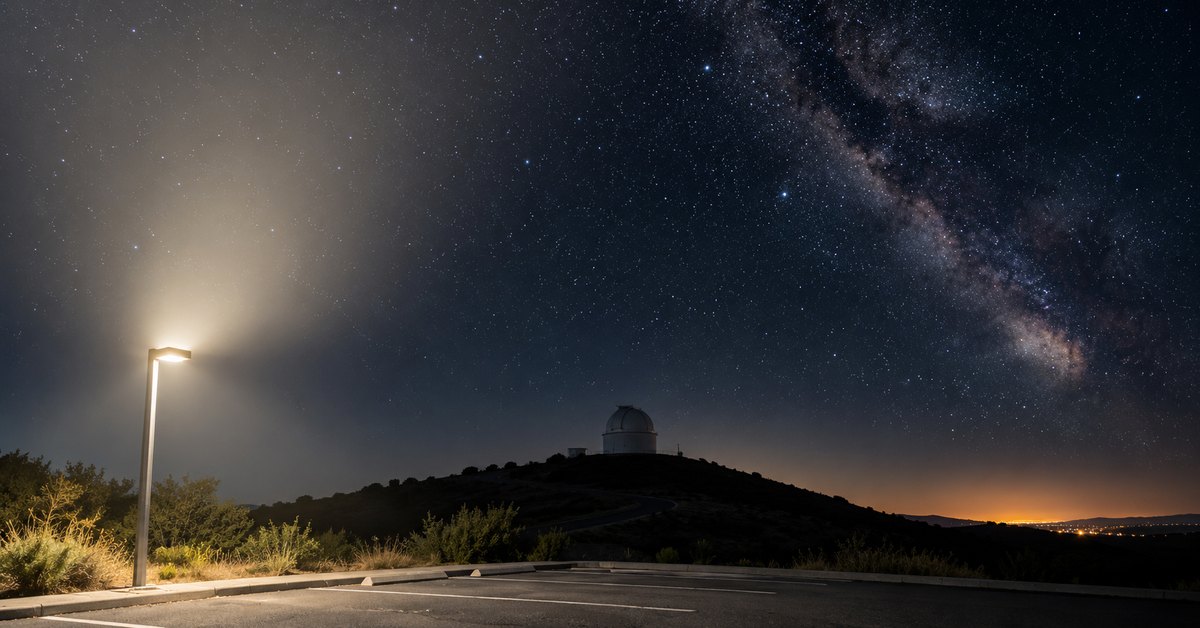
The clearest example of lighting rules going beyond the base standard sits around the Siding Spring Observatory in NSW. The state government's Dark Sky Planning Guideline took effect in February 2023, applying to land regulated under the Dubbo Regional Local Environmental Plan 2022, specifically to protect the observatory's night sky.
Warrumbungle National Park, which surrounds the observatory, was declared Australia's first Dark Sky Park by the International Dark-Sky Association back in 2016, with no street lighting permitted inside the park boundary at all. It isn't a museum piece either: the park was just ranked the second-best stargazing destination in the world by the 2026 Clean Sky Index.
And the designations keep coming. The Sunshine Coast hinterland was certified an International Dark Sky Reserve in 2026 — Queensland's first, and only Australia's second after South Australia's River Murray Dark Sky Reserve. In March 2026, the outback Queensland town of Winton became an International Dark Sky Community, the state's first and the nation's second after Carrickalinga in South Australia. Western Australia has taken a more piecemeal but broader approach: roughly 16 local governments there have now adopted their own outdoor lighting policies specifically to protect dark-sky tourism, even as light pollution creeping north from Perth is already encroaching on sites that used to be reliable for stargazing. None of this is a niche hobby concern either — ABC News reported in 2026 that an estimated 75% of Australian children, more than 3.2 million of them, now live in urban areas where the Milky Way is effectively washed out by artificial light.
Astrotourism built around a genuinely dark sky is real, ongoing economic activity in these regions, and the planning controls protecting it are deliberately stricter than the national baseline in AS/NZS 4282. If a job sits anywhere near a mapped dark-sky zone, checking the local planning overlay is not optional extra diligence, it's a different rulebook.
And it's not just planning overlays anymore. The Australasian Dark Sky Alliance's national petition calling on Federal Parliament to legislate against light pollution had gathered close to 11,000 signatures by late 2026, ahead of being formally presented. No specific protected sites have been nominated in the petition itself — it's a push for the principle, not a list — but it's a clear signal that a voluntary standard plus a patchwork of council complaint processes isn't read as good enough by the people actually losing their night sky.
Give the 2023 edition credit for one real step forward: for the first time, it treats "environmental receivers" — plants, animals and ecosystems — as protected alongside human receivers in its general curfew and non-curfew limits. That's new, and it's not nothing.
But here's the catch: those general limits are exactly that — general. For genuinely sensitive habitat or threatened species, the standard itself steps back and points elsewhere, to the separate Commonwealth light pollution guidelines for a proper risk assessment, rather than setting its own binding fauna-specific thresholds. There's no clause anywhere in AS/NZS 4282 that gives a certifier a hard number to check a design against for bogong moth corridors, turtle beaches or seabird colonies specifically. The protection is a direction to look elsewhere, not a threshold.
The document it points to is the National Light Pollution Guidelines for Wildlife, first published in January 2020 covering marine turtles, seabirds and migratory shorebirds, then expanded in a May 2023 update from the Department of Climate Change, Energy, the Environment and Water (DCCEEW) to add appendices for bats, terrestrial mammals and ecological communities. It's explicitly framed as technical guidance for assessing impacts on species listed under the EPBC Act, not as a mandatory lighting design standard in its own right.
And here's the twist almost nobody in the industry has noticed: those Australian guidelines have since gone global. In February 2024, the Convention on the Conservation of Migratory Species of Wild Animals (CMS) adopted the International Light Pollution Guidelines for Migratory Species at its COP14 meeting in Samarkand — an explicit international adaptation of Australia's own domestic guidelines, extended to also cover migratory landbirds and bats. Other countries are now building binding commitments around a document that started here. Meanwhile, back home, the guideline it's based on still only switches on when a project is significant enough, or close enough to sensitive habitat, to trigger an EPBC Act referral. An enormous amount of ordinary commercial and public outdoor lighting sits in neither net.
Three real examples, each with a different level of evidence behind the light-pollution link, worth being honest about rather than overstating.
Bogong moths. The IUCN added the bogong moth to its Red List as endangered in 2021, following a population decline that CSIRO research traces back to roughly 1980. The mechanism linking light pollution to that decline is now considerably sharper than it used to be: a 2025 study published in Nature (Adden et al., widely covered including by NPR) found that bogong moths navigate using the Milky Way itself as a literal star compass during their long-distance migration — the first time this has been demonstrated in an insect. That makes artificial sky glow a plausible, mechanistic threat in a way vaguer talk of "disorientation" wasn't. Even so, a Western Sydney University release as recent as September 2026 is careful to say the full scale of light pollution's impact on bogong migration specifically still isn't known, echoing an earlier CSIRO review that called the decline driver "unclear" and called for properly designed experiments. Reported decline figures also vary enormously between sources (from roughly 50% to as much as 99.5% depending on the report), which is itself a sign the data isn't settled. What is settled is that the species is in genuine trouble from a combination of drought, pesticides, habitat loss and predation, with light pollution now a mechanistically plausible, if not yet fully quantified, contributor.
Sea turtles. This one has firmer research behind it. Hatchlings navigate toward the brightest horizon, which is normally the ocean reflecting the night sky. Artificial light and sky glow, detectable up to roughly 50km inland of the coastline, can draw them inland instead, leading to death by exhaustion, dehydration or predation. CSIRO research has specifically tested LED streetlights against loggerhead and flatback hatchling sea-finding behaviour. Councils already recommend concrete mitigations: shielding fixtures to face away from the beach and sky, vegetation buffers between lighting and the shoreline, and warmer colour temperatures (3000K or lower, 2700K for anything facing the beach directly) — though see the caveat below before treating colour temperature alone as the fix.
Seabirds. The Australian Government's own light pollution campaign notes that more than 100 seabird species occur in, visit or breed in Australian waters, and that many burrow-nesting petrels and shearwaters only return to their colonies at night, making them acutely exposed to artificial light near those sites. The guidance is specific: avoid lighting over feeding and resting areas and known migration pathways, and where lighting can't be avoided, amber or red light is measurably less disruptive than continuous white light.
A correction worth making, since it's the fix almost every article on this topic (including earlier drafts of this one) reaches for first: a 2026 review in Nature Reviews Biodiversity assessed four broad strategies for reducing ecological light pollution and found that spectral tuning — swapping to warmer colour temperatures — was the weakest of the four, with effectiveness varying widely by species and light intensity. Shielding and full-cut-off optics, dimming or scheduling, and simply not lighting sensitive corridors at all were all rated more reliable. Warm CCT is still worth specifying and councils will keep asking for it, but it's a secondary measure, not a substitute for good optics and good siting.
The 2023 edition of AS/NZS 4282 genuinely tightened the human side of obtrusive light, closing a real loophole in how upward light gets measured, and for the first time gave wildlife a seat at the table in its general limits. But Australia still doesn't have a single standard that sets hard, species-specific thresholds the way it does for people who complain about glare — it points elsewhere instead, to a guideline the rest of the world has since adopted and extended, while the gap at home persists. Until that changes, or Parliament acts on the petition now sitting in front of it, the responsible move on any outdoor lighting job is checking both documents, not just the one your certifier happens to ask for.